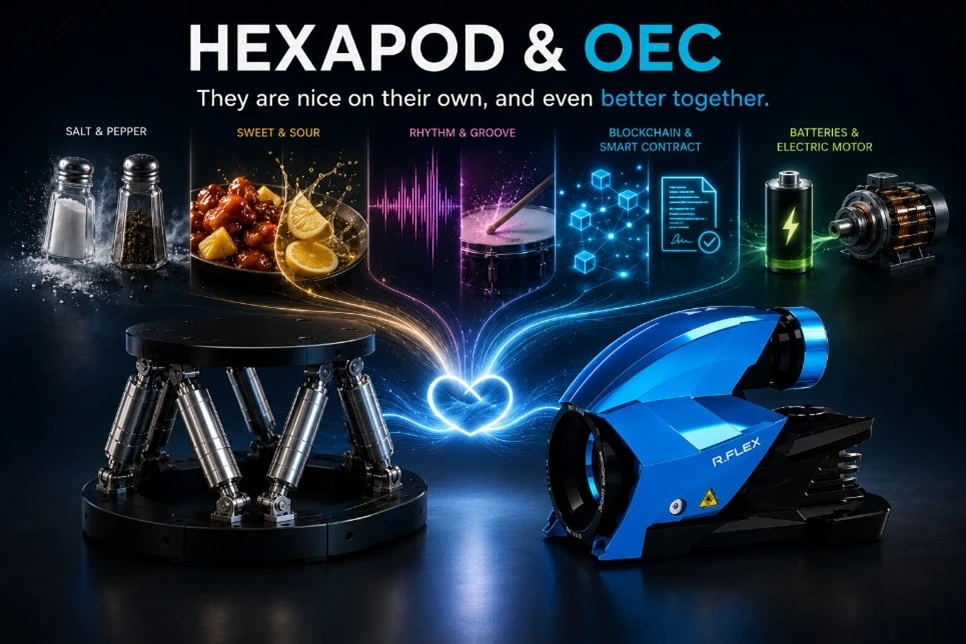
The OEC and a Hexapod are like salt and pepper, or rhythm and groove: good on their own, even better together! On its own, a hexapod gives you precise motion. On its own, a Shack-Hartmann wavefront sensor measures aberrations. Combine the two and you’ll overcome the performance of a fixed optical metrology setup!
What is the OEC®?
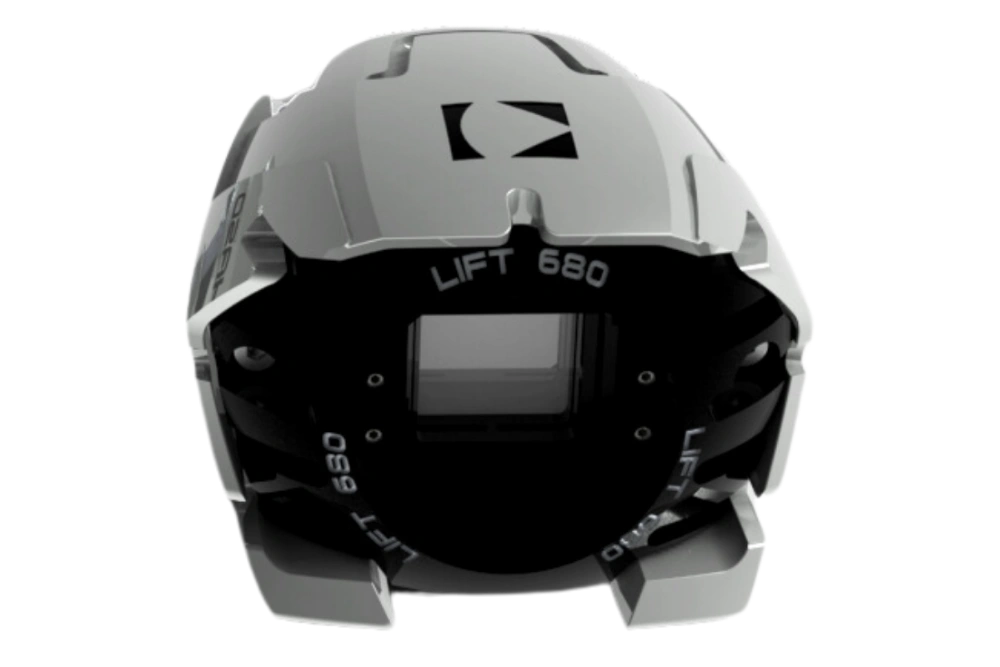
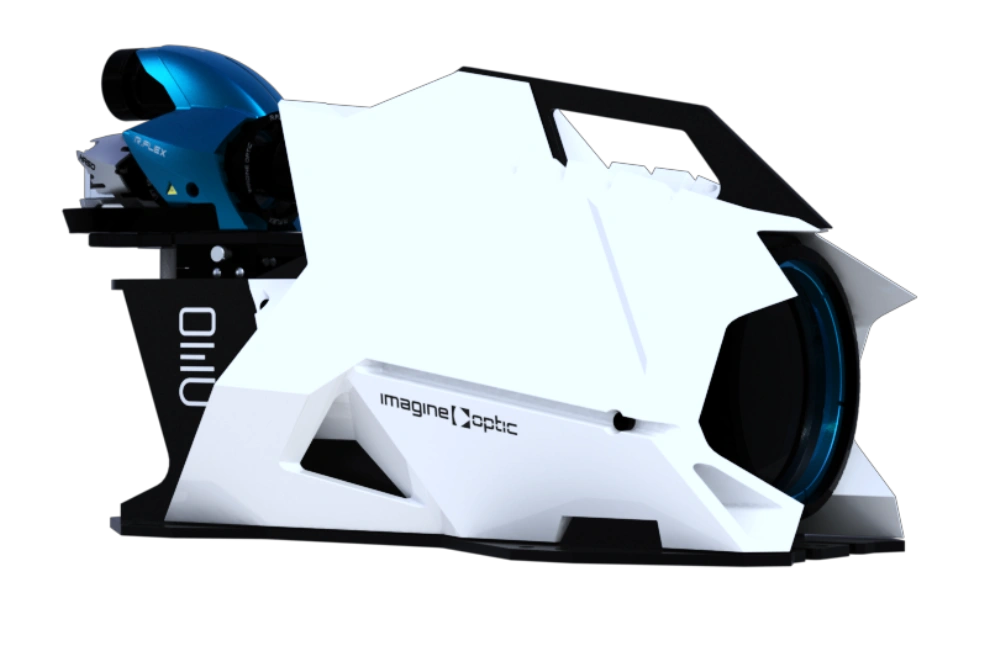
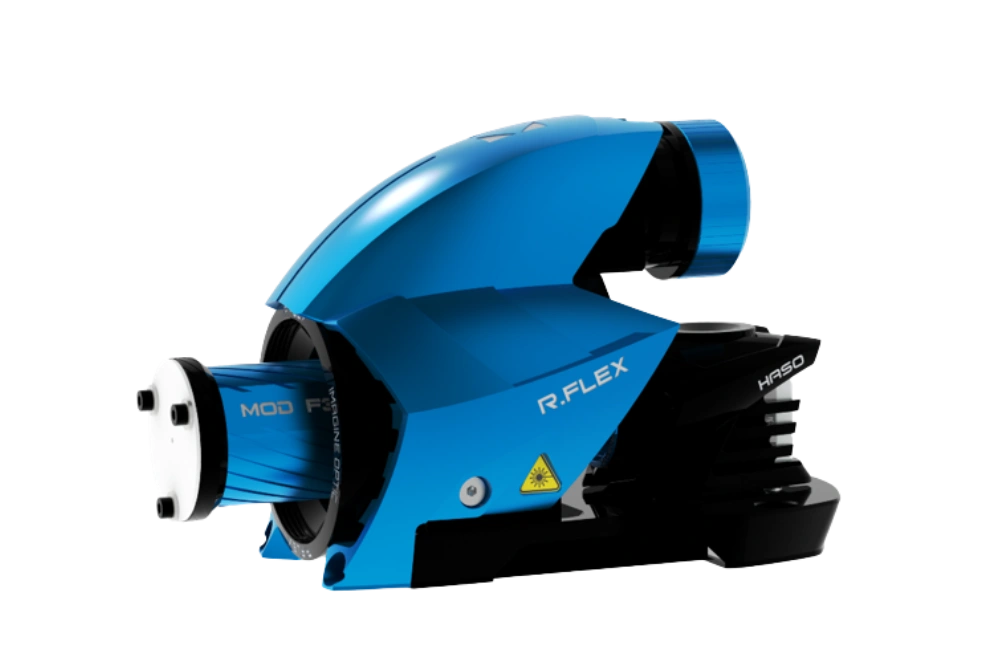
The OEC® (Optical Engineer Companion) is a line of ready-to-use plug-in modules, that lets you set up any test configuration needed to characterize optical components or systems. It pairs a self-aligning illumination platform with a wavefront sensor, and lets you adjust the test beam diameter and aperture at your convenience. Inheriting the Shack Hartmann technology robustness and compactness, the Optical Engineer Companion is very easy to combine with a hexapod for optical metrology demanding applications
What is a hexapod?
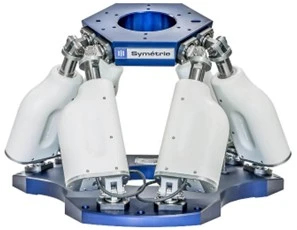
A hexapod is a high-precision motion platform built from six independently controlled actuators, giving movement across all six degrees of freedom: X, Y and Z translations plus rotations.
Since 2001, the French company Symétrie has designed and manufactured hexapods that are both precise and robust. In 2025 they launched their latest model, the BREVA hexapod, with outstanding angular precision. It is a perfect hexapod for optical metrology.

What are the benefits of combining a wavefront sensor with a hexapod?
The combination results in enhanced performances of the OEC, and makes it a perfect solution for demanding applications:
Measure optics larger than your analysis pupil. Associated, the OEC and hexapod can characterize large optics -flat or concave mirrors, for example- even if the testing beam is much smaller than the part. The hexapod walks the pupil across the surface in contiguous or overlapping measurement sub-pupils (sub-aperture stitching), so you measure the whole part without a beam expander the size of the part itself. This is convenient as such optics become exponentially expensive with their diameter.
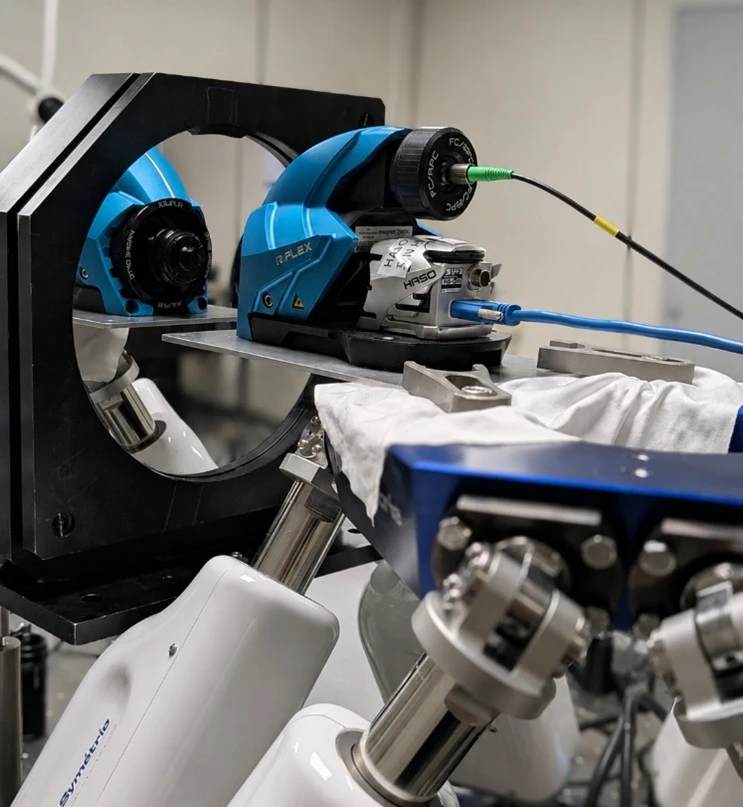
The OEC on a hexapod for optical metrology of a large flat mirror under test
Extend the dynamic range of the measurement. As modern optics, such as freeform optics, push optical path difference to higher and higher values, they can exceed a wavefront sensor capacity. With a hexapod and the OEC, you can shrink the overall sample pupil into small measurement sub-pupils, each presenting a smaller dynamic range of aberrations, therefore compatible with the sensor. Again, by scanning the part with the hexapod, all the sub-pupils can be recombined to obtain a full part characterization.
Increase spatial resolution. As a consequence, defining a measurement pupil smaller than the part under test, allows you to significantly increase spatial resolution, as all the sampling points are distributed on a smaller area.
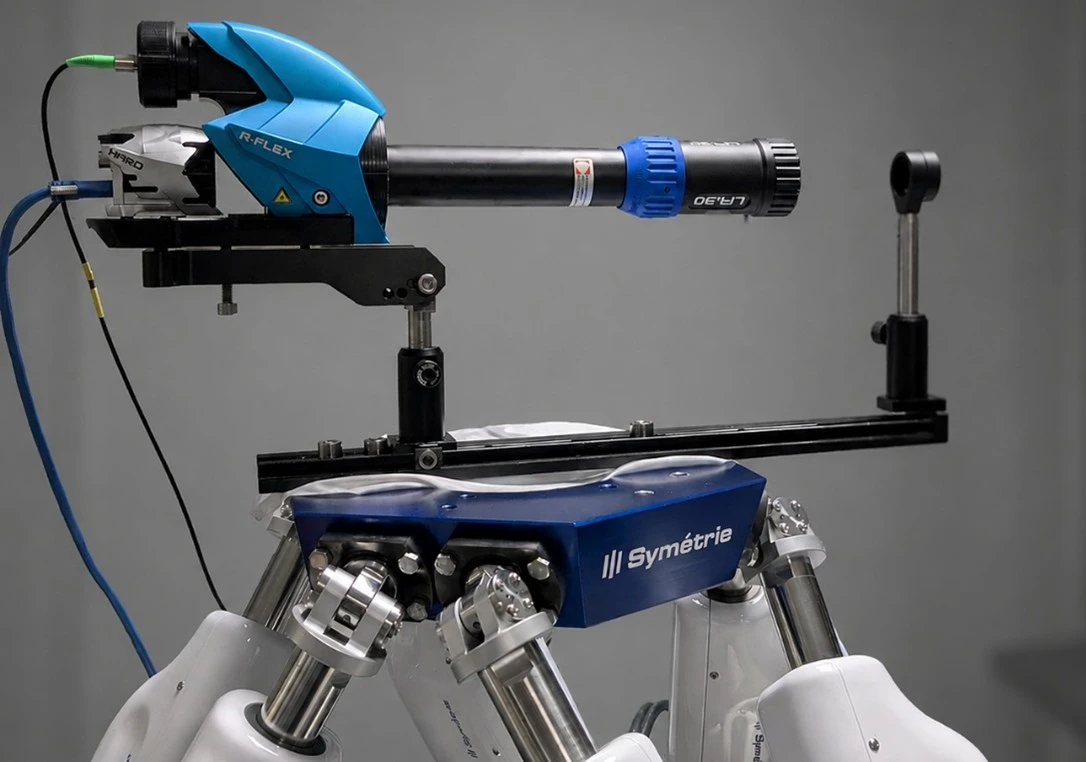
Image caption: Measurement of a concave mirror by angular scanning with the OEC and a hexapod.
Test samples off-axis. Off-axis measurement becomes straightforward, because the hexapod can perform both rotation and translation with respect to the part under test.This allows you to position the OEC not only on-axis but also in the field.
What does Imagine Optic bring to this?
The product synergy is fully reflected on the control software side. Imagine Optic developed automated routines to implement stitching quickly and easily, including the control of the hexapod motion from the metrology SDKs, the calibration of hexapod and wavefront sensor coordinate systems and the acquisition and the recombination of the measurement sub-pupils.
The result is a turnkey solution: Symétrie’s positioning, Imagine Optic’s wavefront sensing, and the routines that tie them together.
Integrating a hexapod into your metrology has never been simpler and faster. Ready to add some salt and pepper and bring out the flavors of your testing? We’re happy to discuss how we can meet your needs! reach us at sales@imagine-optic.com or through the contact form.
Related Products
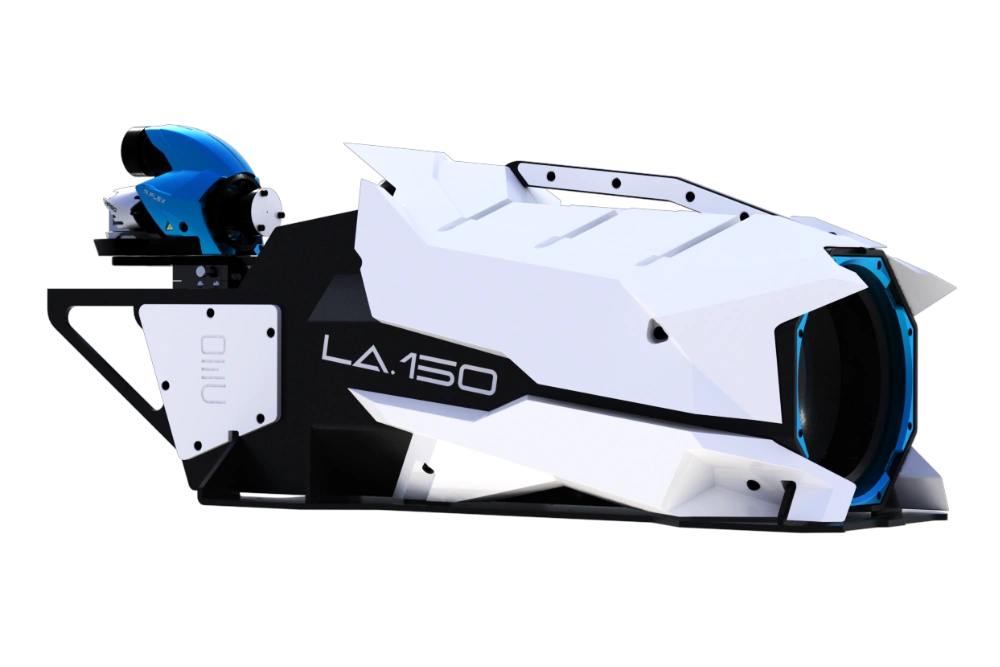
The Optical Engineer Companion
R-FLEX